Product
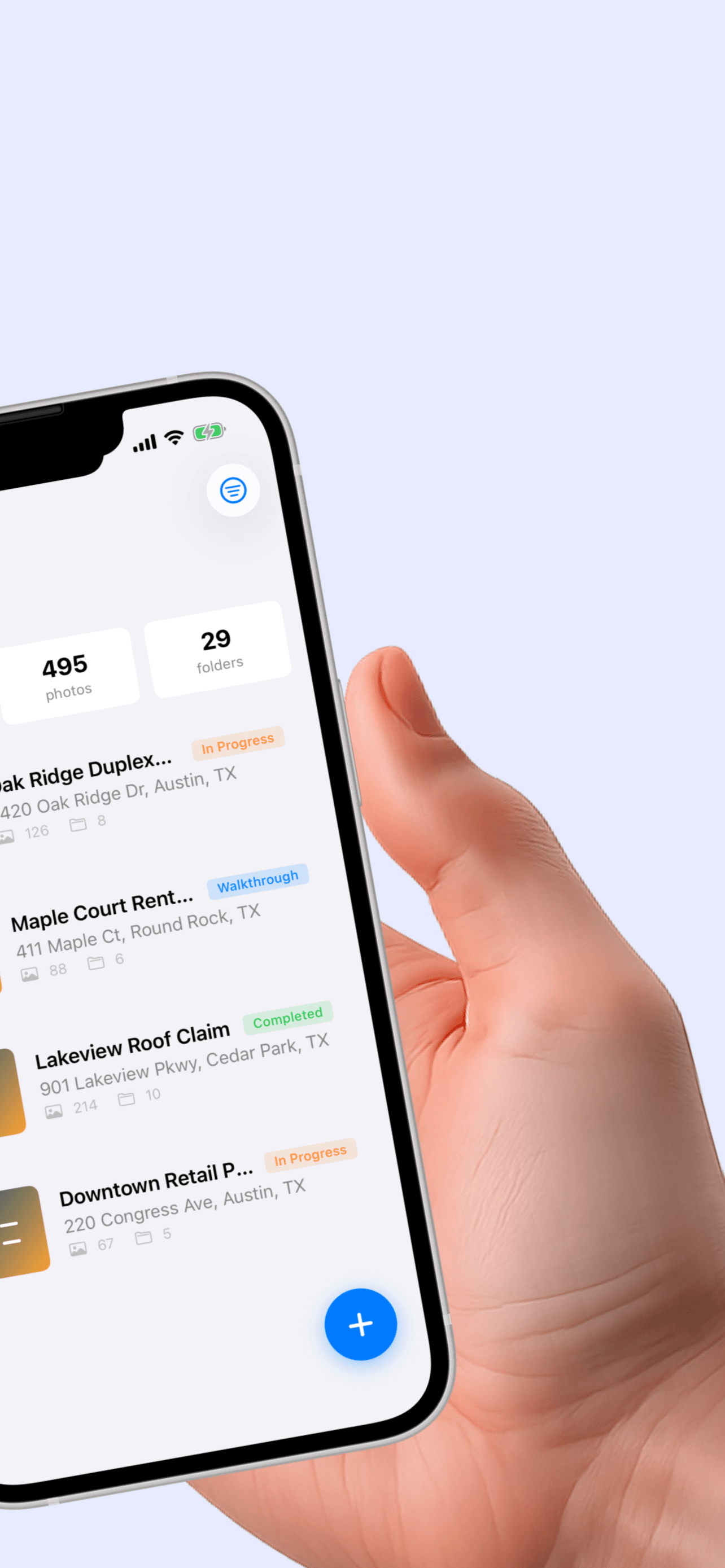
The capture app, built for units with no signal
Evidence starts in the field, which means the field app is the part that cannot fail. It is native iOS, it works offline, and it is on the App Store today.
The field reality
Four properties before lunch, in a concrete stairwell
Inspection software tends to be designed for the office and tested on wifi. The failure modes that matter happen somewhere else.
A vacant unit has the power off, the blinds shut, and no working internet. The person doing the walkthrough is on a schedule and is not going to stand in a doorway waiting for a progress bar. If an app treats connectivity as a precondition for capture, what you get in practice is people going back to the phone camera and promising to upload later.
So the ordering is deliberate: write to disk first, record the capture time, queue the upload, and let the network catch up whenever it can. The inspection is complete the moment the photos are taken, not the moment they reach a server.
Capabilities
What the app does
All of the below is in the shipped build. Nothing on this page is forward-looking.
Capture without a connection
Photos are written to device storage before any network call is attempted. An empty unit with the utilities off and one bar of signal is the normal working environment, so nothing about capture depends on being online.
Uploads resume on their own
Captured items go into a queue that persists across app launches. When the device reconnects, the queue flushes in the background — nobody has to remember to reopen the app in the car park.
Capture time, not upload time
Each photo stores the moment it was taken as a separate fact from when it reached the server. A photo captured Tuesday in a basement and uploaded Thursday from the office still reads Tuesday.
Location, only if you want it
Coordinates can be attached to a capture, and geotagging is a setting the person capturing controls. When location is present it is because someone chose to record it, which is what makes it worth anything.
Protected on the device
Files waiting to sync are written with iOS file protection, so evidence sitting on a phone in a van is not sitting there in the clear.
One account, two surfaces
The same login as the web workspace. What the field captures is what the office reviews, without an export step in between.
Guided capture
The app knows which shots are missing
Templates travel with the inspection, so the standard does not depend on who is holding the phone.
Each room lists its required shots with instructions and an optional reference image, and a room stays open until they are captured. Rooms can repeat per bedroom, so one template covers a studio and a four-bed.
The practical effect is that a new hire on their first turnover produces the same record as someone who has done four hundred, which is the only way a portfolio-wide comparison is ever going to work.
Offline. 12 photos saved on device, queued to upload
- KitchenComplete
- Counters and backsplash
- Appliance interiors
- Under-sink cabinet
- Bedroom 2In progress
- Walls, all four
- Flooring
- Closet interiorOptional
- Bathroom 1Not started
- GarageNot started
Questions
Questions about the iOS app
- Is there an Android app?
- Not today. The native app is iOS only. The web workspace runs in a mobile browser, so an Android user can review and manage work, but templated offline capture is currently an iOS capability.
- What happens to photos if the phone never gets signal at the property?
- They stay on the device in the upload queue and go up when the phone reconnects — typically the moment the inspector drives away. The queue survives closing the app. If an upload fails repeatedly it stops retrying automatically and is surfaced so it can be retried manually, rather than failing silently.
- Do I need the app to use ProFlow360?
- No, but it is where capture is strongest. You can upload from the web workspace, and residents can submit photos through an inspection link from any phone browser without installing anything.
- Does the app work on iPad?
- The app is built and distributed for iPhone. iPhone apps generally run on iPad, but the interface is designed around one-handed capture on a phone, which is how inspections are actually done.
- How much storage does it use?
- It depends on how much you capture and how long items sit unsynced. Photos are held on the device until they upload successfully, so a backlog built up over several offline properties will occupy space until the phone reconnects.
Keep reading
Put it on the phone that does the walkthroughs
Create an account on the web, then sign in on iOS with the same login and run your next inspection from the template.
The free plan covers 3 properties and 100 photos per property.